
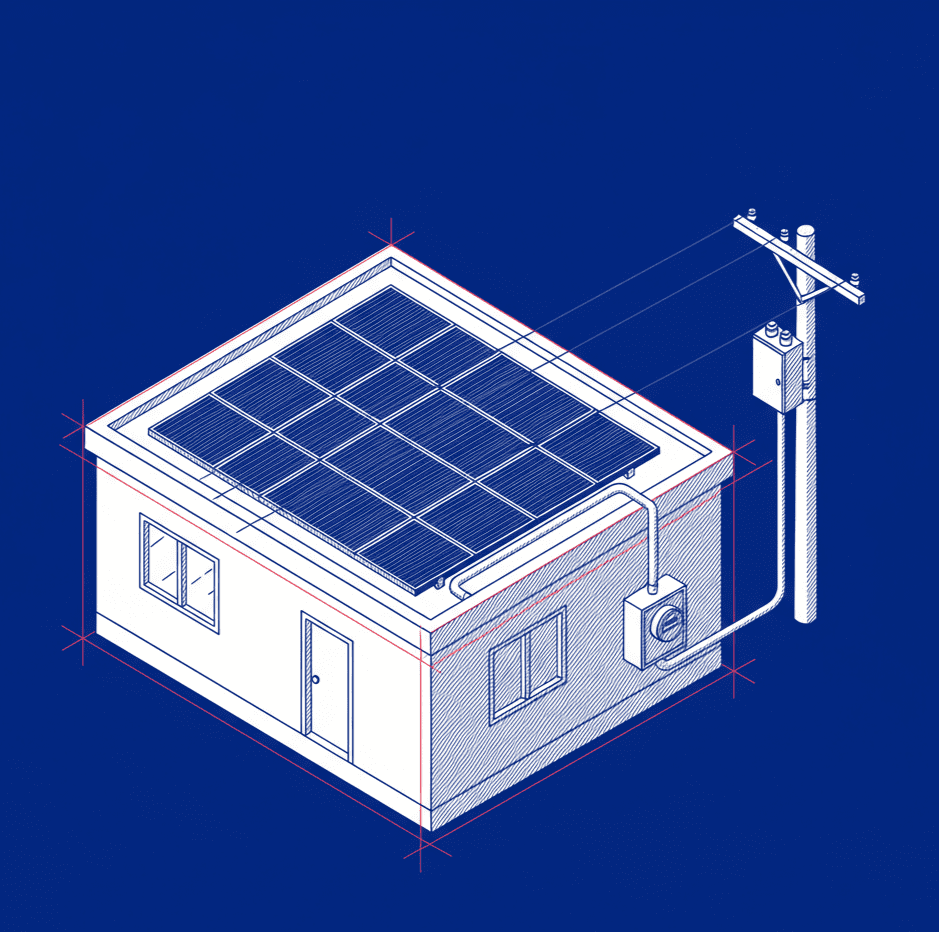
A Net Meter is a special type of electricity meter installed in homes or businesses with solar panels. Unlike a traditional meter that only records how much electricity you consume, a net meter is bidirectional. It measures:
- Import: Electricity you draw from the grid when your solar panels don’t produce enough.
- Export: Surplus electricity your solar panels generate and send back to the grid.
This dual recording enables a billing mechanism called net metering, where your utility calculates the net difference between what you consume and what you export.
Solar Plant vs Consumption Flow
Adjust the sliders to see how solar generation and household consumption interact. The Sankey diagram shows how much energy is supplied by solar, how much is pulled from the grid, and how the net meter balances flows. This calculator is indicative and provides information for better understanding of the concept.
To get a better calculations of the size of the solar project that you may need, use our solar calculator.
How to Get a Net Meter in India: Step‑by‑Step Guide
With solar adoption rising across India, net metering has become the key mechanism that allows households and businesses to save on electricity bills by exporting surplus solar power back to the grid. Superphoton takes care of the whole process for a hassle free adoption of the solar plant.
Step 1: Install a Solar PV System
Before applying for net metering, you need a grid‑connected solar photovoltaic (PV) system. This can be rooftop solar panels or a larger installation, depending on your needs. The system must comply with your state’s technical standards and safety norms.
Step 2: Apply for Net Metering
Submit an application to your local DISCOM (Distribution Company). Most states now allow online applications through their electricity board portals. You’ll need to provide:
- System capacity details (kW rating)
- Location and consumer number
- Technical specifications of panels and inverter
Step 3: Submit Required Documents
Typical documents include:
- Proof of identity and address
- Electricity bill copy
- Solar system purchase/installation certificate
- Single‑line diagram of the system
Step 4: Technical Feasibility Report (TFR)
The DISCOM will conduct a feasibility study to ensure your system can safely connect to the grid. This checks transformer capacity, grid stability, and compliance with state regulations.
Step 5: Inspection and Approval
Once feasibility is cleared, DISCOM officials inspect your installation. If everything meets standards, they approve the connection.
Step 6: Net Meter Installation
Finally, a bidirectional net meter (or smart meter) is installed. This records both import (electricity drawn from the grid) and export (surplus solar sent to the grid). From this point, your billing shifts to a net basis — you pay only for the difference between imports and exports.
State‑Wise Variations
While the broad process is similar across India, each state has its own rules on:
- Maximum system size allowed
- Tariff credits for exported units
- Application timelines
For example, states like Delhi, Maharashtra, and Karnataka have streamlined online portals, while others may still require physical applications.
How can Superphoton help you with the netmeter?
At SuperPhoton, we simplify every step of your solar journey. From handling the paperwork with DISCOM to coordinating approvals, installation, and net meter setup, our team ensures a smooth, hassle-free experience. We take care of the technical details and compliance requirements so you can focus on enjoying clean energy and reduced electricity bills. With our end-to-end support, getting your on-grid solar project becomes effortless and worry-free.
Can Batteries Be Included in an On-Grid Solar System?
A standard on-grid solar system relies entirely on the grid for backup. While this setup reduces electricity bills, it does not provide power during outages. This is where batteries come into play. By integrating battery storage into an on-grid system, you create what’s known as a hybrid solar setup.
Benefits of a Hybrid Solar System
- Uninterrupted Power Supply: Batteries ensure you have electricity even during grid failures.
- Optimized Energy Usage: Store surplus solar energy during the day and use it at night, reducing dependence on the grid.
- Greater Control: Decide when to use stored energy versus grid power, giving you flexibility and independence.
- Enhanced Savings: Net metering credits plus battery backup maximize both financial and practical benefits.
- Future-Ready: Hybrid systems are adaptable to evolving energy needs and smart home technologies.
Net Meter: The Cornerstone of PM Surya Ghar Yojana
The success of the PM Surya Ghar Yojana hinges on the net meter, which acts as the bridge between your rooftop solar system and the utility grid. Under this scheme, households are encouraged to generate their own clean energy and feed surplus electricity back into the grid. The net meter records both the power you consume from the grid and the excess you export, ensuring accurate billing and crediting of solar units. Without this mechanism, the financial benefits of the scheme—like reduced bills and energy credits—would not be possible. In essence, the net meter transforms rooftop solar from just a source of power into a smart investment tool, making it the cornerstone of India’s push toward widespread solar adoption.