
When you look at most rooftop solar installations in the northern hemisphere, you’ll notice a common theme: the panels are pointed towards south. This isn’t a coincidence — it’s a deliberate choice rooted in physics, geography, and efficiency.
Maximizing sunlight exposure: In the northern hemisphere, the sun’s path arcs across the southern sky. Having panels pointed towards south ensures they receive the longest and most direct exposure throughout the day.
Energy yield: Proper orientation can boost electricity generation by up to 30% compared to poorly aligned panels. That’s a significant difference in both savings and sustainability.
Consistency: South‑facing panels capture sunlight more evenly across seasons, balancing winter’s lower sun with summer’s higher arc.
Why It Matters Less Today? What if you cannot point it to the south?
Advances in solar technology are reshaping this old rule:
- High‑efficiency panels: Modern photovoltaic cells convert more sunlight into electricity, even when the angle isn’t perfect. This means east‑ or west‑facing panels can still deliver 75–85% of the output of south‑facing ones.
- Micro‑inverters and optimizers: These devices allow each panel to operate independently. If one panel gets less sun due to orientation or shading, it doesn’t drag down the performance of the entire system.
- Tracking systems: Some installations use mechanical trackers that follow the sun’s movement across the sky, eliminating the need for a fixed south orientation.
- Smart economics: In regions with time‑of‑use electricity pricing, east‑ or west‑facing panels can actually be more profitable because they generate power during peak demand hours (morning and evening).
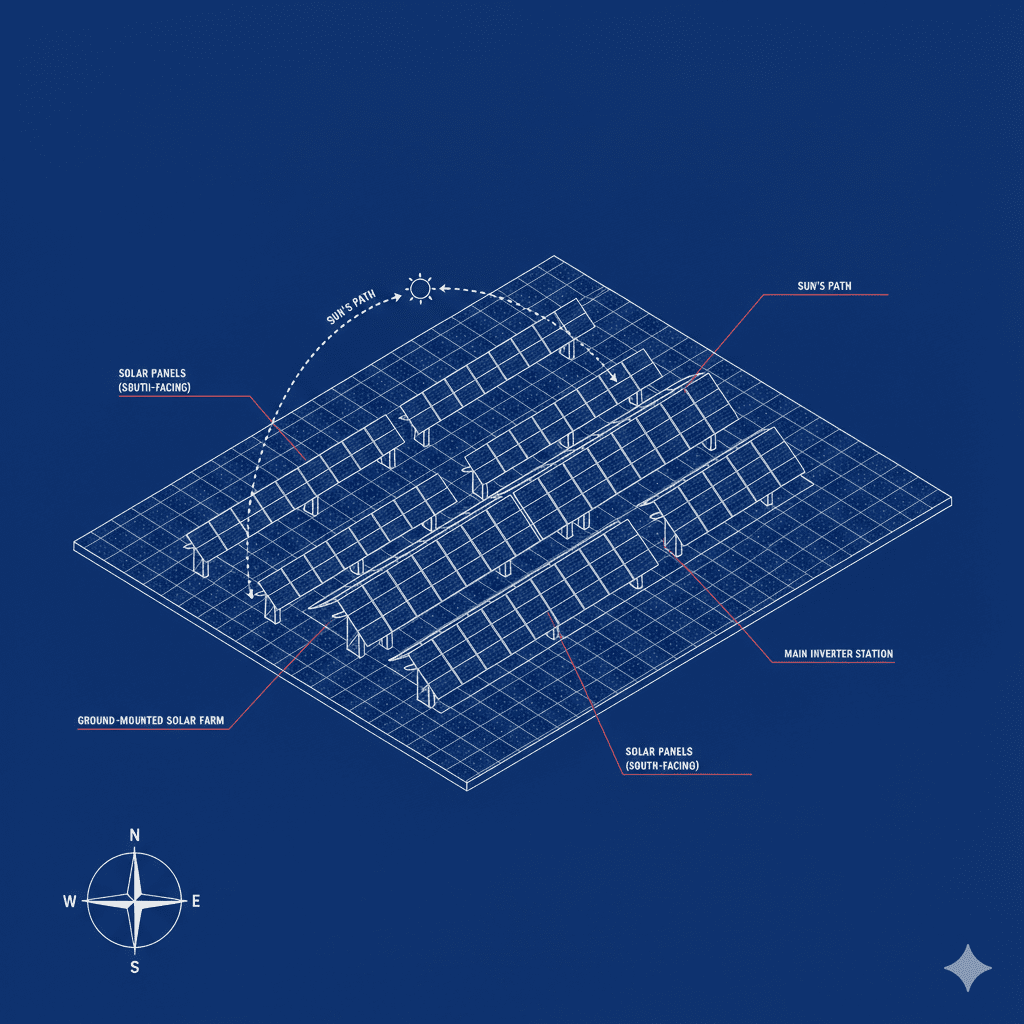
Geographic Theory: Why the Sun Appears in the South?
For anyone living in the northern hemisphere, the sun is almost always seen in the southern part of the sky at noon. This isn’t a coincidence — it’s a direct result of Earth’s geometry and motion.
Earth’s Tilt: The planet’s axis is tilted about 23.5°. This tilt means that as Earth orbits the sun, different hemispheres lean toward or away from it, creating the seasons.
Sun’s Path: At mid‑northern latitudes (like most of North America, Europe, and Asia), the sun rises in the east, arcs across the southern sky, and sets in the west. That’s why the noon sun is always south of overhead.
Seasonal Variation: In summer, the sun’s arc is higher and longer, while in winter it’s lower and shorter. But even then, the midday sun remains in the southern sky.
Opposite in the Southern Hemisphere: For people south of the equator, the noon sun appears in the northern sky, because their hemisphere tilts differently relative to the sun.
Case study of New Barrackpore, West Bengal
The following image shows the output of a Solar panel pointed towards south in New Barrackpore, however the results wont change too much for anywhere across India. The following graphs explains how the production is affected across the months.
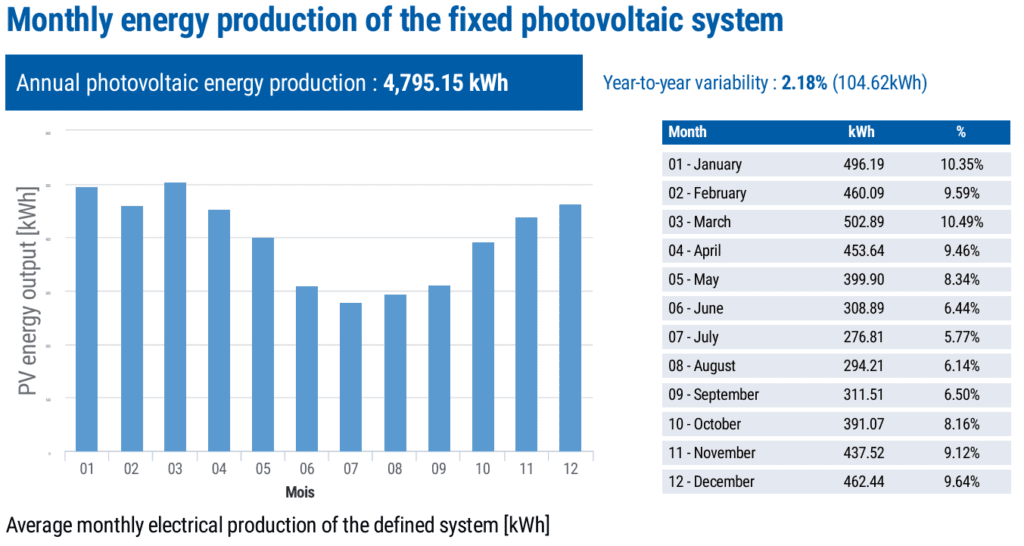
On an average the 1Kw setup produces 4 units per day. If you average out your production and usage for the whole year, and with the usage of a on grid setup, you can save upto 90%+ on your electricity bill. An extra solar panel can actually balance out the dip during couple of mounts in middle of the year. Or even nulify the fact that you have to panels pointed towards south.
Deep Research with PVGIS.
While reading about this topic we came across this research agency who are providing with tools for a deeper reasearch on this topic.
What PVGIS Offers
- Solar radiation data: Hourly, daily, or monthly values of solar radiation for almost any location worldwide.
- Performance simulations: Estimates of how much electricity a photovoltaic system would produce at your exact coordinates, with different panel orientations and tilt angles.
- Seasonal variation: Clear graphs showing how production changes across the year.
- Battery integration: Tools to model how storage can help you use more of the electricity you generate.
- Maps and datasets: Ready‑to‑print maps of solar resources and PV potential by country or region.
- APIs: For advanced users, automated access to PVGIS data for large‑scale analysis.
To know more, visit PVGIS.
What Superphoton Provides?
Tailored system design: Instead of one‑size‑fits‑all, Superphoton analyzes your roof, local climate, shading, and energy usage to craft a system optimized for your needs.
On‑grid and off‑grid solutions: Whether you’re in a city with reliable grid access or a remote location, they design systems that fit seamlessly.
Efficiency through technology: By integrating high‑quality panels, inverters, and optional battery storage, they ensure maximum energy yield with minimal losses.
Smart balancing: Their engineered solutions weigh cost, government subsidies, available space, and long‑term sustainability to deliver the most efficient outcome.
Future‑ready extras: From EV chargers to solar pumps, Superphoton designs systems that can expand with your lifestyle or business needs.