
Solar panels come in several technologies, each built for different budgets, roof space, climates, and performance goals. This guide explains the main types, compares them by performance, price, and use case. The goal: by the end you should be able to pick the right panel type for your home or project.
In simple words, types of solar panels boil down to type vs RoI.
Quick Overview of Main Panel Type
These are cell-level improvements that push efficiency and reduce degradation. They are commonly applied to mono or n-type wafers to create premium panels.Advanced silicon variants TOPCon, PERC, HJT
Made from single-crystal silicon. Highest efficiency and best space-to-power ratio. Typically used where roof space is limited.Mono
crystalline
Made from multiple silicon crystals. Lower efficiency than mono but cheaper. Good for larger roofs and budget installs.Poly
crystalline
Lightweight and flexible. Lowest efficiency but can be cheaper per panel and useful for large-area or curved surfaces.Thin Film
CdTe, Ca‑Si
Bifacial
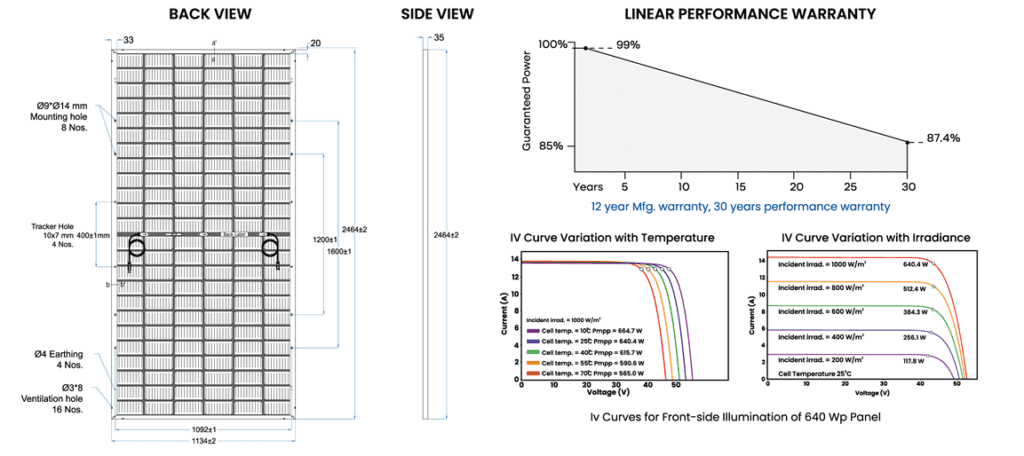
Captures light from both front and rear faces to boost energy yield. Often paired with high-efficiency cells and used in ground-mount or reflective-roof installations.
Solar Panel Efficiency vs Cost
Interactive scatter plot comparing solar panel technologies. X-axis shows cost, Y-axis shows efficiency, and bubble size reflects efficiency.
Best Recommendation for Indian Setting
TOPCon (Tunnel Oxide Passivated Contact) solar panels stand out among the different types of solar panels available today, especially for the Indian setting. Built on advanced N-type cell technology, TOPCon modules deliver higher conversion efficiency — often above 22% — which means more electricity generation per square meter, a crucial advantage where rooftop space is limited. Unlike traditional PERC panels, TOPCon cells have lower degradation rates and better performance in high temperatures, making them ideal for India’s hot climate. Their resistance to light-induced degradation ensures long-term reliability, while bifacial TOPCon modules can capture reflected sunlight from bright and dusty surfaces, further boosting energy yield. With India’s focus on cost-effective, durable, and high-output renewable energy solutions, TOPCon emerges as one of the most promising types of solar panels for both residential rooftops and utility-scale projects.
Frequently Asked Questions
What are the main types of solar panels available today?
The most common types of solar panels are Monocrystalline, Polycrystalline, Thin Film (CIGS and CdTe), Bifacial Mono, TOPCon N-type, HJT, and PERC. Each has different efficiency levels, costs, and suitability depending on installation needs.
Which type of solar panel is best for Indian rooftops?
TOPCon and Monocrystalline panels are often considered best for Indian rooftops because they offer high efficiency and perform well in hot climates. Their durability ensures long-term savings despite higher upfront costs.
Are thin-film solar panels suitable for residential use?
Thin-film panels are lightweight and flexible, making them useful for certain applications. However, they generally have lower efficiency compared to crystalline panels, so they are less common for residential rooftops where space is limited.
What is the average lifespan of different types of solar panels?
Most crystalline panels (Monocrystalline, Polycrystalline, TOPCon, HJT, PERC) last 25–30 years with minimal degradation. Thin-film panels typically have a shorter lifespan of around 15–20 years.
How do bifacial solar panels work?
Bifacial panels generate electricity from both sides — the front side captures direct sunlight, while the rear side absorbs reflected light from surfaces like concrete or sand. This makes them highly effective in bright and dusty environments.
Which type of solar panel offers the best return on investment (ROI)?
High-efficiency panels like TOPCon, HJT, and Monocrystalline often provide the best ROI in India. Although they cost more initially, their higher energy yield and longer lifespan reduce payback time compared to lower-cost, lower-efficiency options.